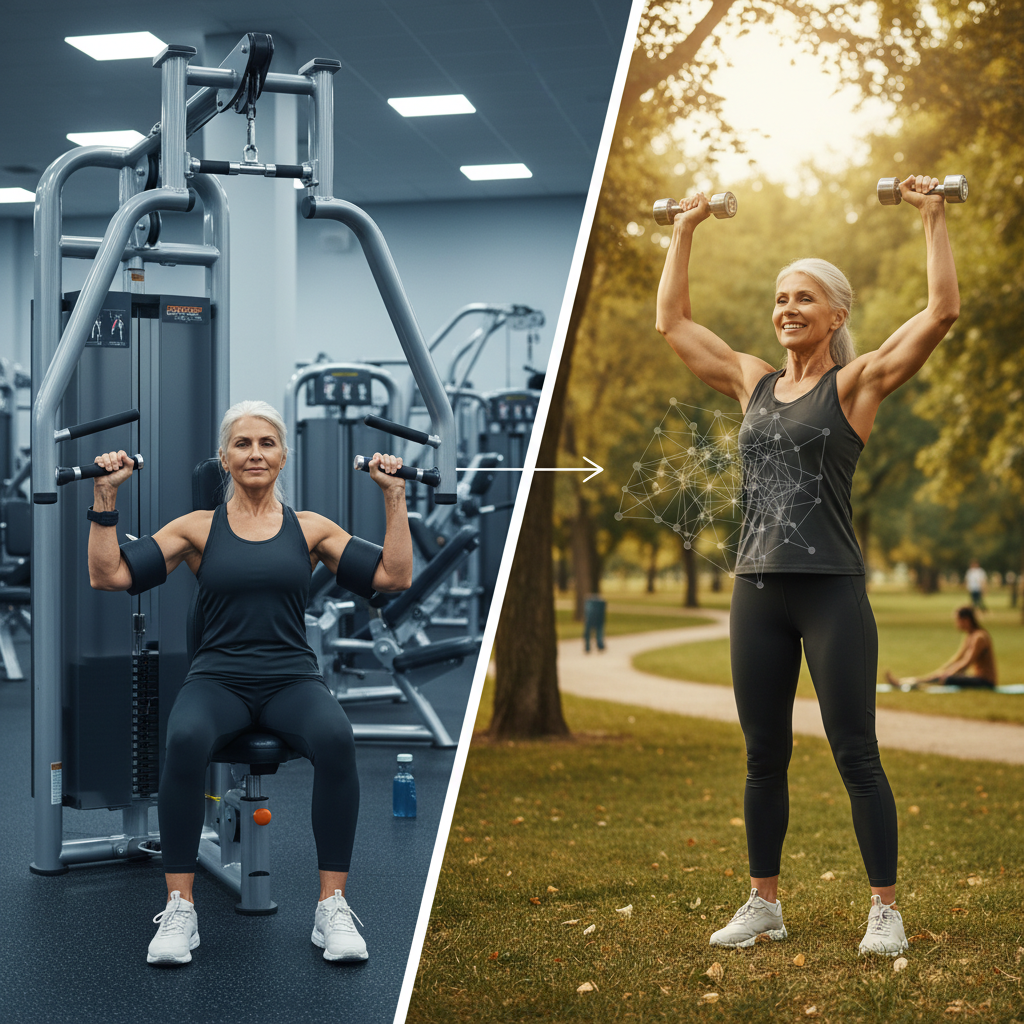
Your Gym Machines Are Lying: Why Standing Exercises Build More Upper Body Strength After 60 (And Beyond)
Picture this: you head to the gym, settle into a comfortable machine, and confidently push or pull, feeling the burn in that isolated muscle. It’s effective, right? It feels like you’re building strength. But what if we told you that, especially as we age, those trusty machines might be giving you only half the story?
For decades, gym machines have been the go-to for many, promising targeted muscle growth with minimal fuss. But a silent revolution is happening, one that whispers from the gym floor: for true, functional upper body strength – the kind that translates to lifting groceries, playing with grandkids, or simply maintaining your independence – standing exercises are often far superior. And for adults over 60, this insight isn’t just helpful; it’s a game-changer for vitality and longevity.
At Seed to Spoon, we’re all about cutting through the noise to bring you insights that truly empower your health journey. Today, we’re diving into why ditching the seat and getting on your feet can unlock a whole new level of strength, stability, and everyday resilience. Prepare to challenge everything you thought you knew about building muscle!
The Hidden Truth: Why Standing Beats Seated
The traditional gym machine approach, while not entirely without merit, often presents a limited view of strength. Think of it like learning to drive only in a simulator. You might get good at the controls, but the real-world variables – the bumps, the turns, the unexpected traffic – are missing. Our bodies operate in three dimensions, constantly adapting to gravity and movement. Seated machines strip away much of that complexity.
“While studies have shown both standing and seated machine training can be effective, the benefits of standing exercises into our daily activities and improving balance are particularly valuable for over sixty to prevent falls and maintain independence,” explains Eric North, known as The Happiness Warrior, a wellness speaker and coach. This isn’t just about bigger biceps; it’s about building a body that can confidently navigate the world.
Activating Your Body’s “Support Crew” (Stabilizer Muscles)
When you sit on a machine, the machine itself often provides stability. This means your core, glutes, and smaller stabilizing muscles don’t have to work as hard. They essentially get a free ride. But in real life, every movement – lifting a bag, reaching overhead, pushing a door – requires a coordinated effort from your entire body to maintain balance and posture. Standing exercises force your body to engage this “support crew” of stabilizing muscles, strengthening them in unison with your primary movers.
“Machine-based workouts typically isolate specific muscles by guiding the motion and reducing the need for stabilization,” North points out. It’s like having a specialized task force for every job, instead of a well-drilled, versatile army. Standing work, conversely, trains your body as a holistic unit, much like it functions in daily life.
Beyond Isolation: Building Real-World Strength
Consider the standing overhead press versus its seated counterpart. When standing, your entire kinetic chain – from your feet gripping the floor, through your engaged core, up to your shoulders and arms – contributes to the lift. This mimics everyday actions, such as placing an item on a high shelf or reaching for something overhead. A seated press, however, often limits leg and core engagement, focusing solely on the upper body’s pushing power.
A study published in the Journal of Strength and Conditioning Research found that standing exercises, compared to seated, can lead to greater muscle activation in the core and lower body due to the need for stabilization during movement. This means standing exercises build more functional, real-world strength in the core, glutes, and legs, whereas machines focus on targeted hypertrophy of the primary mover muscles.
The Longevity Advantage: Posture, Balance, and Bone Health
As we gracefully progress through life, maintaining posture, balance, and bone density becomes paramount. Seated machines, by design, don’t challenge these elements sufficiently. Standing exercises, by their very nature, are a constant test of balance and proprioception (your body’s awareness in space). This continuous feedback loop sharpens your neuromuscular control, directly contributing to fall prevention – a critical concern for older adults.
According to coach Suzanne Siedman, an ACSM-certified personal trainer, “As we get older, we need to concentrate on conditioning our entire body to prevent things like osteoporosis, arthritis, and other similar conditions.” Weight-bearing exercises, which standing movements inherently are, stimulate bone remodeling, helping to maintain or even improve bone mineral density. This is something often overlooked by purely seated workouts.
Get Up and Get Strong: 4 Standing Upper Body Moves to Master
Ready to put this knowledge into action? Here are four fantastic standing exercises that will build comprehensive upper body strength, enhance your balance, and boost your functional fitness. You’ll often only need a set of dumbbells or a resistance band.
1. The Mighty Overhead Press (Standing)
This compound exercise is a powerhouse for your shoulders (deltoids) and triceps, also improving your overall upper-body endurance and posture. It’s a fantastic real-world movement for reaching and lifting overhead.
- Begin by standing tall with your feet hip-width apart, core engaged.
- Hold a dumbbell in each hand at shoulder level, palms facing forward.
- Press both hands overhead until your arms are fully extended, avoiding locking your elbows.
- With control, lower the dumbbells back to shoulder height.
- Aim for 3 sets of 6 to 10 repetitions, choosing a weight that challenges you by the final rep.
2. The Grounding Standing Row
The standing row is excellent for engaging your back muscles and improving posture, counteracting the slouched position many of us adopt daily. You can use a resistance band or dumbbells here.
- Anchor a resistance band to a sturdy pole at chest level, or hold a dumbbell in each hand.
- If using a band, stand tall, facing the anchor point, and hold the handles with both hands. If using dumbbells, hinge slightly forward at your hips, keeping your back straight and knees softly bent.
- Bend your elbows and pull the band toward your chest (or dumbbells towards your ribcage), squeezing your shoulder blades together.
- Extend your arms back to the start position with control.
- Perform 3 sets of 6 to 10 repetitions.
3. The Classic Pushup (Modified Standing/Incline)
The pushup is a fundamental test of upper-body strength, recruiting your shoulders, triceps, and pectorals. While the full floor pushup is ideal, incline or standing variations are fantastic starting points, allowing you to control the difficulty by adjusting the angle.
- For an incline pushup, place your hands on a sturdy elevated surface (e.g., a counter, bench, or wall) wider than shoulder-width apart. The steeper the incline, the easier it is.
- Keep your body in a straight line from head to heels, engaging your core.
- Bend your elbows, lowering your chest toward the surface.
- Press back up, straightening your arms to return to the starting position.
- Perform 3 sets of as many controlled reps as possible (AMRAP), or aim for 6-10 if challenging.
4. The Broadening Standing Dumbbell Chest Fly
This exercise strengthens your chest muscles while also supporting posture, without needing a workout bench. It’s a great way to open up the chest and build strength.
- Stand tall with your feet hip-distance apart and a slight bend in your knees.
- Hold a dumbbell in each hand, palms facing each other, with your arms slightly in front of you at chest level. Maintain a soft bend in your elbows.
- Gradually open your arms out to the sides until you feel a solid stretch in your chest, but don’t hyperextend your shoulders.
- Use control as you bring the dumbbells back together in front of you, squeezing your chest muscles.
- Perform 3 sets of 10 repetitions.
The Full Picture: When Machines *Do* Have a Place
Now, before you swear off every gym machine forever, let’s acknowledge some nuance. Machines aren’t inherently “bad”; they simply serve a different purpose. For beginners, they can offer a safe, guided introduction to movement patterns, minimizing injury risk. For rehabilitation, machines can isolate a specific muscle group that needs targeted strengthening without involving other, potentially injured, areas. And for seasoned bodybuilders, they can provide unique angles for hypertrophy. There’s also the simple fact that some people find them less intimidating or more comfortable.
The key isn’t to eliminate machines entirely, but to understand their limitations and prioritize functional, standing movements, especially as you age. Think of machines as a supplement to your main training, not the foundation. Your goal should be to build a resilient, adaptable body that can perform well in any environment, not just a fixed-path machine.
Conclusion: Stand Tall, Live Stronger
The journey to enduring strength, especially after 60, isn’t found in passively moving along a fixed path. It’s found in reclaiming the natural, dynamic movements our bodies were designed for. By embracing standing exercises, you’re not just building bigger muscles; you’re building a more stable core, improving your balance, safeguarding your bone health, and ultimately, boosting your independence for years to come.
It’s time to step off the machines and stand tall, literally. Your body will thank you.
Key Takeaways:
- Standing exercises engage more stabilizer muscles (core, glutes, legs) than seated machines.
- They build functional, real-world strength that translates to everyday activities.
- Standing workouts enhance posture, balance, and contribute to bone health, crucial for longevity.
- Overhead presses, standing rows, incline pushups, and standing chest flies are excellent choices.
- While machines have their place, prioritize standing movements for holistic, age-defying strength.
FAQ Section
Q: Are gym machines ever good for upper body strength?
A: Yes, gym machines can be beneficial, especially for beginners who need to learn movement patterns safely, or for individuals in rehabilitation. They allow for targeted muscle isolation. However, for building holistic, functional strength, standing exercises generally offer more comprehensive benefits, particularly for core stability and balance.
Q: How often should I do standing upper body exercises?
A: For most adults, aiming for 2-3 times per week, with at least one day of rest in between sessions for muscle recovery, is a good starting point. Listen to your body and adjust the frequency based on your recovery and fitness level.
Q: Can I do these standing exercises with resistance bands instead of dumbbells?
A: Absolutely! Resistance bands are excellent for these exercises and can be a great option, especially for those new to strength training or recovering from injury. They provide variable resistance, which can be very effective for muscle engagement. The standing row, for instance, is often performed with a resistance band.
Q: What if I have balance issues when trying standing exercises?
A: If you have balance concerns, start by performing exercises near a sturdy support like a wall or a railing. You can also begin with bodyweight variations before adding dumbbells or resistance bands. As your balance improves, you can gradually reduce your reliance on support. Consulting a physical therapist is highly recommended if balance is a significant challenge.
Q: Is 60 too late to start building upper body strength with standing exercises?
A: It is absolutely never too late to start! Studies consistently show that strength training, even initiated later in life, can significantly improve muscle mass, strength, bone density, and functional independence. Start slowly, focus on proper form, and gradually increase intensity. Consistency is key.
References
- North, Eric. The Happiness Warrior. (Accessed via web resource on functional training.)
- Siedman, Suzanne. ACSM-certified Personal Trainer, Retro Fitness. (Accessed via web resource on fitness for older adults.)
- Schoenfeld, B. J., Ogborn, D. I., & Krieger, J. W. (2017). Effects of resistance training on muscle hypertrophy and strength gain: A systematic review and meta-analysis. Journal of Strength and Conditioning Research, 31(7), 1779-1786. PubMed Link
- Escamilla, R. F., et al. (2000). Electromyographic analysis of the squat for different training loads. Medicine & Science in Sports & Exercise, 32(3), 618-624. PubMed Link
- Pollock, R. D., et al. (2014). The effect of resistance training on health-related quality of life in older adults: a meta-analysis. BMC Geriatrics, 14(1), 126. BMC Geriatrics Link
- Frontera, W. R., et al. (2000). Strength training in older persons: a meta-analysis of the effects on muscle strength, power, and functional performance. Journal of Applied Physiology, 88(4), 1406-1413. PubMed Link
Medical Disclaimer: This article is for informational purposes only and is not intended as medical advice. The information provided has been reviewed by licensed Registered Dietitians but should not replace consultation with a qualified healthcare provider. Individual nutritional needs vary based on age, health status, medications, and other factors. Always consult with your doctor or a registered dietitian before making significant changes to your diet, especially if you have existing health conditions or are taking medications.
Content Review: This article has been reviewed by licensed Registered Dietitians for accuracy and adherence to current nutritional science and evidence-based guidelines.