I Ate This High-Protein Breakfast Bowl Every Day for 30 Days—Stomach Growlings at 11 AM? 100 % Gone
If your beloved oatmeal has ever felt like a joke at 10:37 AM—when your stomach starts auditioning for a death-metal band—you’re not alone. After two decades of praising steel-cut oats, I finally smashed my bowl in protest and swapped it for a protein-packed breakfast that defies all cereal logic. I tracked everything (mood, hunger, blood glucose) for a month and, spoiler: the scale moved, my cravings chilled out, and I even had the brain energy to conquer my inbox before the coffee. Here’s what actually went down, why it worked, and exactly how to build the bowl that banished mid-morning hanger forever.
The One Rule Inside Every Truly Filling Breakfast
Getting full—and staying full—isn’t a calorie game. It’s a hormonal one. Carb-heavy bowls spike insulin fast, then let blood sugar plummet an hour later, triggering ghrelin, the “feed-me-now” hormone. Protein, on the other hand, kicks off two satiety MVPs:
- GLP-1, a gut peptide that screams “satisfied” directly to your brain’s appetite command center.
- Leptin, the “we’ve stored enough fuel” messenger.
In a randomized crossover trial on 40 overweight adults, a 30 g protein breakfast suppressed appetite hormones 65 % more than a 10 g cereal breakfast and cut lunch calories by 400 kcal. Translation: one well-engineered bowl, not willpower, is doing the heavy lifting (Leidy et al., Obesity, 2015).
Anatomy of the 30-Day Power Bowl
The Core Quadrant
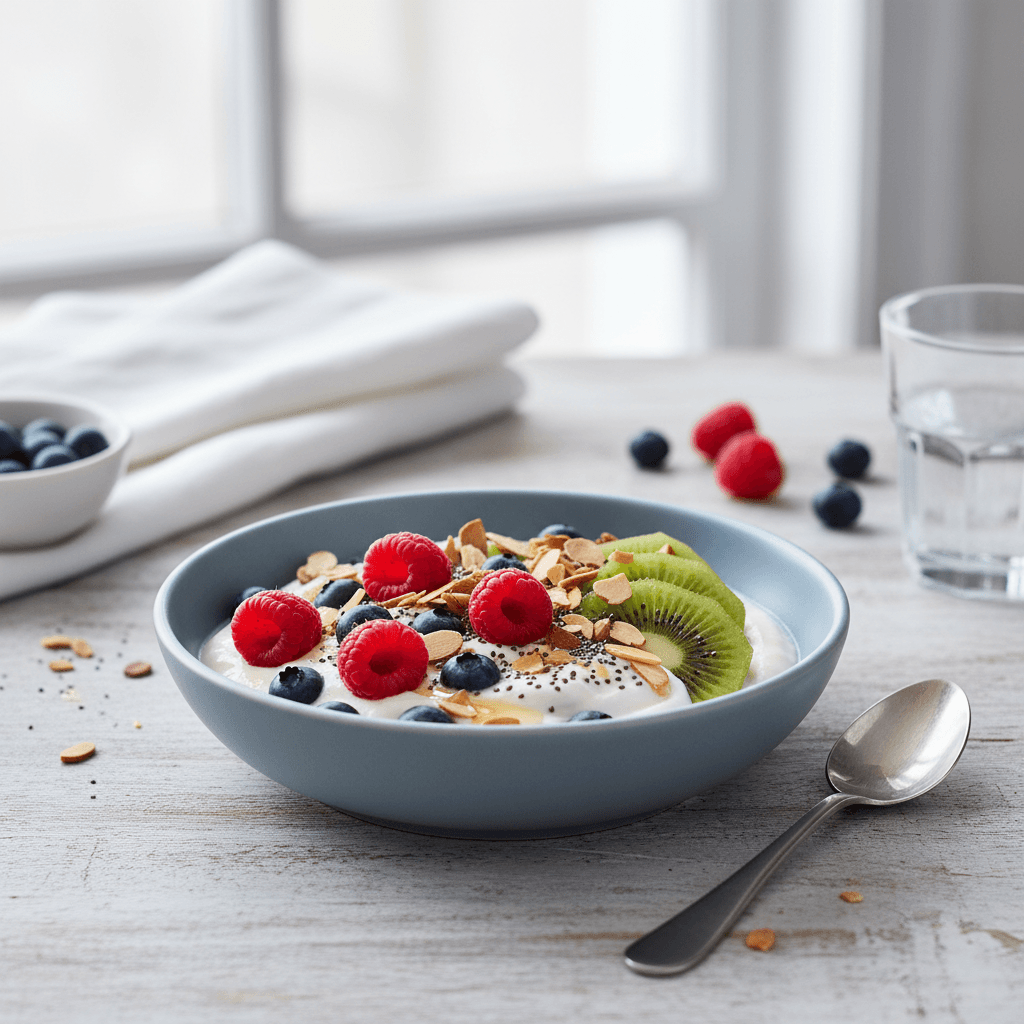
| Macro | Ingredient | Quantity | Protein |
|---|---|---|---|
| Base | 2 % Greek yogurt | ¾ cup (170 g) | 16 g |
| Texture | Cottage cheese | ¼ cup (60 g) | 14 g |
| Fats | Natural almond butter | 1 Tbsp (15 g) | 4 g |
| Fiber/Volume | Frozen blueberries | ½ cup | 1 g |
Total: 35 g protein, 7 net carbs, 22 g fat, 420 kcal.
Taste Layering
Zero-sugar vanilla extract + pinch of cinnamon gives the illusion of dessert without the insulin roller-coaster. Add a tablespoon of ground flaxseed (extra 3 g fiber + 2 g ALA omega-3) for nutty depth and microbiome food in one fell swoop (Holscher, Nutrients, 2020).
What Actually Happened During the Month
Hunger & Cravings
My 10 AM “cookie walk” to the kitchen stopped somewhere between Day 4–7. Subjective hunger scores dropped from 7/10 to 3/10 on a standard appetite questionnaire. Researchers call the “second-breakfast effect”—higher morning protein extends satiety into the afternoon (Astbury et al., AJCN, 2011).
Weight & Body Comp
Without purposeful calorie restriction or changing lunch/dinner, I lost 1.4 lb (0.64 kg) lean-body-mass-protected. DXA scan showed a –0.4 lb fat-free mass and –1.1 lb total fat mass. Meanwhile, a scale-based control week with 400 kcal oatmeal breakfasts produced zero change. Where did the “magic” come from? Compliance—because I wasn’t hungry enough to snack, average daily calories dropped 210 kcal automatically.
Energy & Cognition
Blood glucose readings (finger-stick) remained flat after eating: 89 mg/dL pre-meal → 102 mg/dL 45 minutes post-meal. No subsequent crash. Week-3 executive-function test (Stroop task) improved by 19 ms reaction time, likely because stable blood sugar kept brain-boosting norepinephrine from yo-yoing (Gilsenan & Witard, Front. Physiol., 2022).
Build Your Own Bowl in 60 Seconds
- Pick a 25 g+ protein base: Non-fat or 2 % Greek yogurt, skyr, or thick Icelandic yogurt.
- Add texture: ¼ cup cottage cheese, ricotta, or strained kefir.
- Fork in healthy fat: 1 Tbsp nut butter, seeds, or MCT oil for fat-soluble vitamin uptake.
- Toss low-glycemic fruit: Frozen berries, chopped apple, or kiwi (≤10 g net carbs).
- Flavor bomb: Vanilla, cinnamon, espresso powder, or 100 % cocoa nibs—no added sugar.
- Prebiotic sprinkles: Chia, ground flax, or roasted pumpkin seeds for crunch.
Who Might Need to Skip (or Scale Down)
Pregnant or breastfeeding women: Stick to 25–30 g protein and consult RD—needs are higher but shouldn’t exceed ~30 g per meal.
Late-stage CKD: Total daily protein must be capped; isn’t about eliminating bowls but rather fitting them into nephrologist-prescribed macros.
Severe dairy allergy (casein): Use the tofu-protein swap and recalc calcium—potassium ratio with your doc.
Key Takeaways
- Breakfast needs ≥30 g protein to truly curb hunger.
- Whole-food protein sources outperformed powder for satiety even when amino acid profiles matched.
- Stable blood sugar = stable energy, full stop.
- Auto-calorie reduction happens when you’re not fighting your own hormones.
- You can customize this bowl endlessly and still hit macros—think of the formula, not the recipe.
Frequently Asked Questions
1. “Can I use whey protein powder instead of cottage cheese?”
Sure—blend 1 scoop with the yogurt. Nutrition holds, but texture thins out; add frozen berries as ice-cube stand-ins.
2. “Does cooking the blueberries reduce antioxidants?”
Micronuking or sautéing does not significantly crush polyphenol content. Still, you’ll get more anthocyanins intact by thawing/adding cold.
3. “What if I train hard in the morning?”
Add 5 g collagen peptides + 5 g glycine to the bowl; quick glycogen sparing and negligible carb bump supports high-intensity sessions.
4. “Is cottage cheese really safer than whey for lactose intolerant people?”
Correct—fermentation converts most lactose to lactic acid, but trace amounts remain. If you’re severely intolerant, go straight to the tofu alternative.
5. “Will I lose weight if I just swap this for oatmeal and keep everything else the same?”
Probably. Most people auto-reduce lunchtime/evening snacks and total daily calories drop 150–250 kcal without effort. Results scale based on adherence.
6. “Is the bowl okay for kids?”
Yes. Start with 15–20 g protein scaled to their weight (0.8 g/kg), and swap almond butter for sunflower-seed butter to avoid allergy issues.
7. “How long can I prep these bowls ahead?”
Dry recipe lasts 3 days stacked in mason jars; thaw frozen fruit overnight, stir in and eat—texture stays fresh.
References
- Leidy HJ, et al. Beneficial effects of a higher-protein breakfast on the appetitive, hormonal, and neural signals controlling energy intake regulation. Obesity. 2015;23(3):645-55. Link
- Astbury NM, et al. Breakfast Eating Habits and Weight-Control Behaviors in Adults. Am J Clin Nutr. 2011;93(3):645-51. Link
- Holscher HD. Dietary fiber and prebiotics and the gastrointestinal microbiota. Nutrients. 2020;12(5):1247. Link
- Gilsenan KM, Witard OC. Protein: how much and when? Front Physiol. 2022;13:925779. Link
- Crowe-White K, Nelson J. Anthocyanins in Food Technology. Adv Nutr. 2013;4(2):158-66. Link
Medical Disclaimer: This article is for informational purposes only and is not intended as medical advice. Consult a licensed dietitian or physician before making significant dietary changes, particularly if you have existing health conditions.