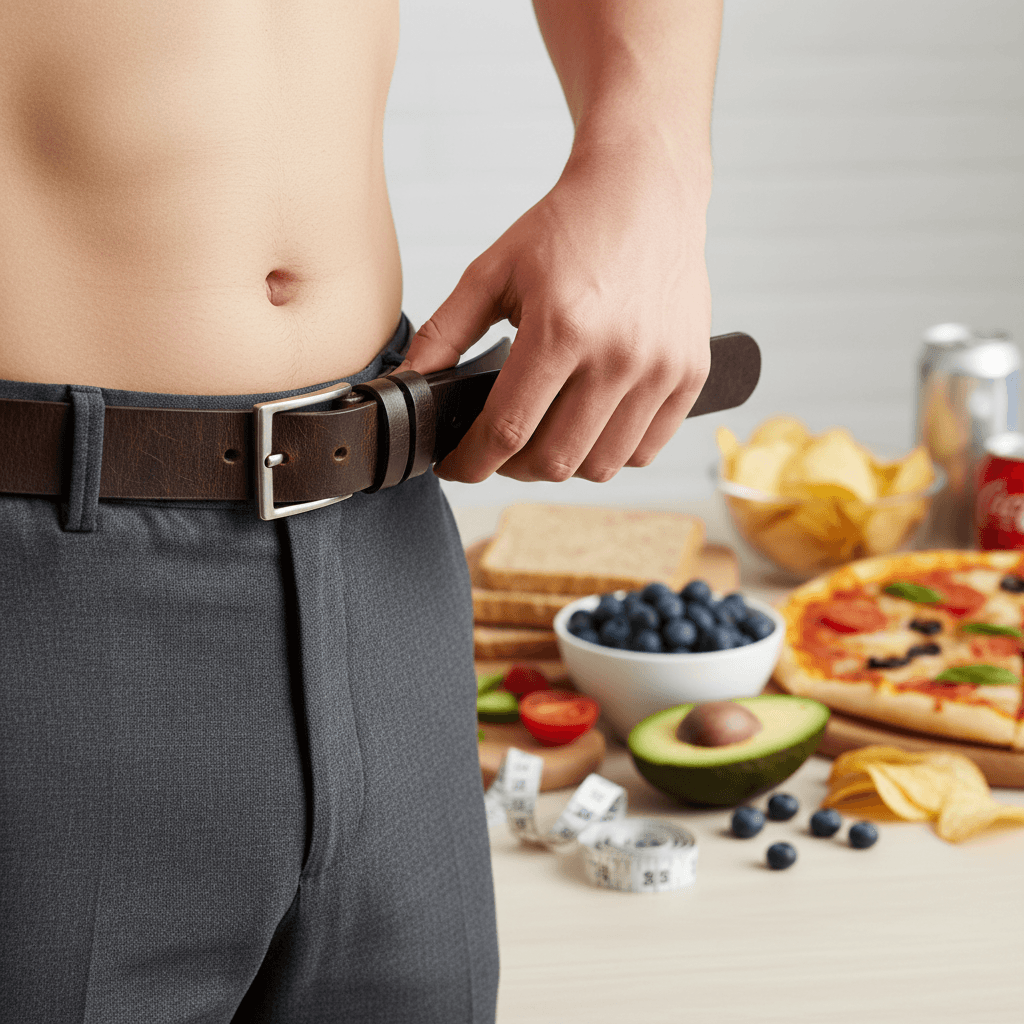
Forget the Scale—Your Belt-Hole May Be Predicting Heart Trouble Before Your BMI Even Budges
Last week, my buddy Carlos bragged that his BMI officially reads “normal.”
Two hours later we’re splitting tapas in Miami when he lifts his shirt to show off his “tech bro abs,” and the waiter politely asks, “Is the beer baby part of the next course?”
Everyone laughed—except the echo in my head whispering the stat I’d just read: if your waist is half your height (or more), heart-disease alarms start ringing even when the scale says you’re “fine.”
New Brazilian data just confirmed it, and it’s quietly re-writing how cardiologists screen for the #1 killer in the U.S.
Below, we’ll translate the study, show you the 60-second measuring trick you can do while Netflix queues up, and unpack what this actually means for your breakfast, workouts, and medical charts.
A Quick Refresher on the Numbers Everyone Pretends They Understand
Body-Mass Index is basically kg ÷ m². Say you’re 5 ft 9 in, 180 lb—that’s 27.1, tagged as “overweight.” Problem is, it sees muscle the same as marshmallow fluff. Docs have known this for years, but it’s easy to calculate from chart data, so the clipboard survives.
Waist-to-height ratio (WHtR) flips the script: simply divide waist inches ÷ height inches. Anything ≥ 0.5 triggers the caution flag. No labs, no calibration, no nurse with an attitude.
The São Paulo Heart-Artery Calcium Study
What They Did
- 2,721 adults aged ~48 (62 % female), no coronary calcium at baseline
- Three body measures: BMI, waist circumference, WHtR
- CAC scan at year 0 and again at year 5
What They Found
After adjusting for blood pressure, lipids, diabetes, and smoking, WHtR ≥ 0.5 predicted new coronary artery calcium 18 % vs. 10 %. The grumpy metabolics—blood sugar spikes, sky-high triglycerides—still mattered, but visceral fat’s independent fingerprint was unmistakable.
Lead investigator Dr. Thiago Bosco Mendes summed it up: “Waist-to-height was the last marker standing after we threw everything we had at the model.”
Why Your Spare Tire (Even a Mini-One) Is a Social Saboteur for Your Arteries
Visceral fat behaves like an arch-nemesis in a Netflix drama. It releases IL-6, TNF-α, and other inflammatory agents that literally weaponize cholesterol against artery walls. Think of foam cells as tiny vandals spray-painting LDL onto brickwork; visceral fat supplies the spray paint, then blames the bricks.
The kicker? Subclinical inflammation begins before you hit the clinical obesity BMI threshold of 30. A 5 ¢ paper-tape measurement is suddenly a crystal ball.
The 60-Second WHtR Check You Can Do During a Commercial Break
- Grab a soft tape.
- Stand barefoot against a wall, measure your height to the nearest inch (or cm).
- Breathe out, measure your waist at the belly button once—not where your saggy jeans land.
- Divide: waist ÷ height.
- If the answer is ≥ 0.50, it’s a yellow flag; ≥ 0.60 is a red one.
Real-World Translation: “Okay, Now What?”
Eat Like the Ratio Matters
- Drop ultra-processed carbs first. One meta-analysis showed cutting added sugar for 8 weeks shrank visceral fat 4-7 % independently of total weight loss (Am J Clin Nutr, 2019).
- Fiber is king. Target 30 g soluble + insoluble fiber daily—for instance, add ½ cup lentils to one meal; that alone contributes 8 g.
- Protein pacing. Divide protein evenly (20-35 g) across breakfast, lunch, and dinner. Higher protein at one sitting increases visceral fat loss versus skewing it all at dinner (Nutrients, 2022).
Move Like You’re Losing Inches, Not Pounds
- HIIT 3×/week—12 minutes works. Cycling sprints (20 sec all-out, 10 sec rest, x10) dropped visceral fat 17 % in 12 weeks with no total weight change (Obesity, 2018).
- NEAT hacks. Walking phone calls while pacing burns an extra 120 kcal/day—equal to running 12 miles per month.
Special Cases: When This Formula Flakes Out
If you’re over 65, sarcopenia may mask visceral adiposity; check WHtR alongside hand-grip strength tests.
Zooming Out: Where the Data Still Debates
Two caveats: The cohort leaned white (57 %) and Latinx (28 %); replication in Black and Asian cohorts is scarce. Second, this was a five-year follow-up—CAD builds over decades. WHtR may be one whisper in a choir of risk melodies.
Key Takeaways (Read This Before You Leave)
- A waist-measure belt test is better than your bathroom scale for picking up cardio risk earlier.
- Aim for a WHtR under 0.5; 0.5–0.6 is a caution zone; ≥ 0.6 demands lifestyle overhaul.
- You can’t “target” belly-fat with gimmicks—whole-diet quality, NEAT increases, and metabolic-strength training are the only proven levers.
- Discuss calcium-scoring with your doctor if your ratio edges up, especially at age 40+.
Frequently Asked Questions
Q1: Does WHtR work for kids?
Yes—pediatric guidelines use the same 0.5 cut-off. In kids, a rising WHtR over time is postulated as a sentinel of adult metabolic risk.
Q2: Muscle gain lifts my waist size—am I doomed?
Unlikely. True hypertrophy raises waist circumference but usually plummets the ratio because overall height or muscle distribution counters it. If you’re lean muscled, WHtR mis-categorizes 2–3 % of males; follow up with labs.
Q3: How often should I re-check?
Monthly is noise. Every 3 months while you’re in active change mode is realistic for meaningful trend-lines.
Q4: Is tape measure accuracy really the weak link?
Cheap metal tapes stretch after ~80 uses. Buy a <$5 cloth tailor’s tape; coffee-shop temperature drifts produce < 0.1 inch error.
Q5: Any gender or ethnicity tweaks?
The 0.5 cut-off holds across sexes but Asian populations start to see elevated risk at 0.46. Talk to your physician about nuanced guidelines.
References
- Mendes TBL et al. Waist-to-height ratio and incident coronary artery calcium: the ELSA-Brasil cohort. The Lancet Regional Health, 2025. https://www.thelancet.com/PIIS2667-193X(25)00292-3/fulltext
- Schwingshackl L et al. Effects of soluble vs insoluble fiber on visceral fat—systematic review. Am J Clin Nutr, 2019;109:68-79.
- Heymsfield SB et al. Assessment of obesity—body mass index and beyond. N Engl J Med, 2023;388:1939-1950.
- Keating SE et al. High-intensity interval training reduces visceral fat independent of weight loss. Obesity, 2018;26:167-173.
- Macdonald J et al. Protein intake patterns and subcutaneous/visceral fat loss. Nutrients, 2022;14:3308.