The Cheffing Combat Vet: Why One Marine Switched MREs for Microgreens and What That Means for Your Diet
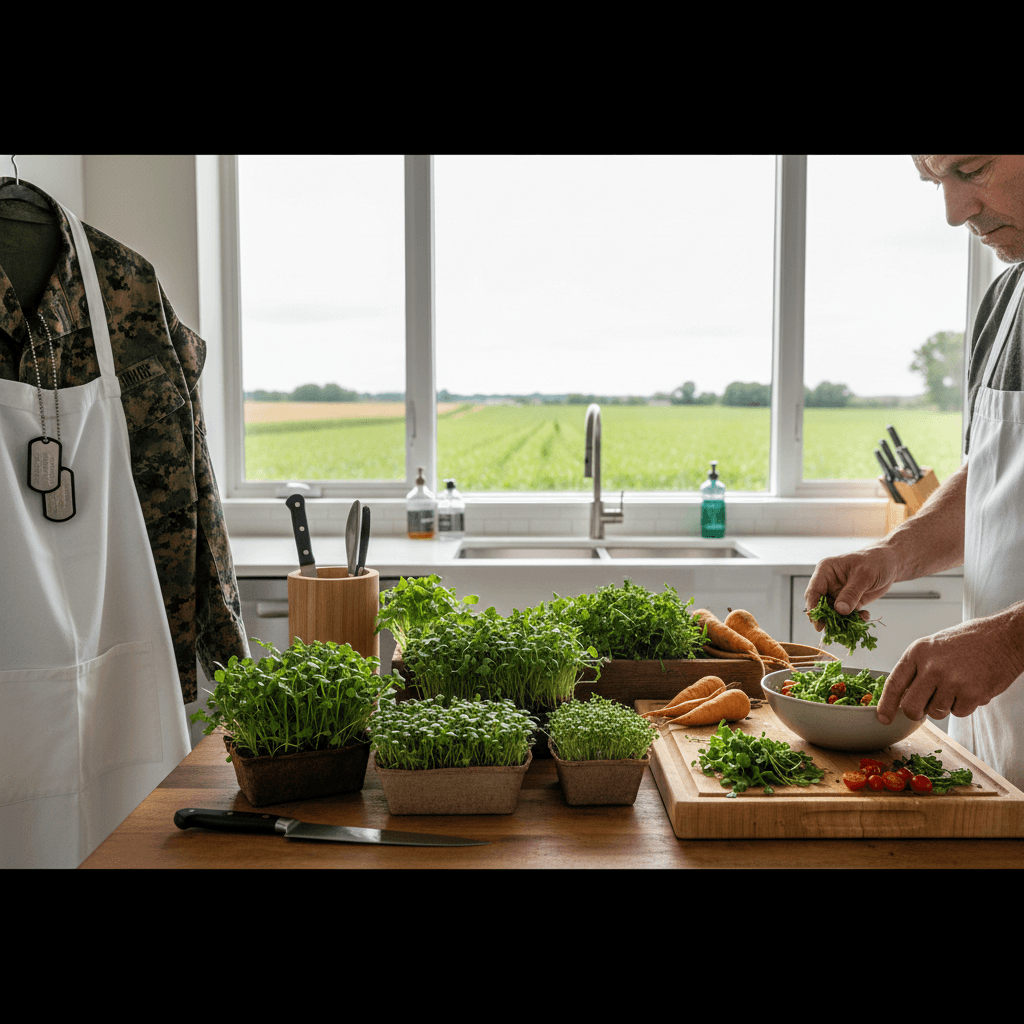
Ronnie Penn pulls a razor-sharp boning knife across a stalk of fresh fennel faster than most people can peel a banana. Ten years ago, he was doing the same motion—only it was a bayonet sliding along a zip-tie in a sandstorm. The transition from Force Recon Marine to executive chef isn’t just a cool LinkedIn makeover; it’s a real-world experiment in what happens when you feed a body that was built in combat with ingredients that actually heal it.
From Mess-Hall Gravy to Microgreens: The Veteran’s Nutrition Timeline
Penn’s “Day 0” was stuffing MREs into magazine pouches. Rehydrated ravioli, chili-mac, and energy gels kept him alive, but the aftermath was a different story. Chronic joint pain, wrecked gut health, and the kind of inflammation that makes 5 AM workouts feel like litter duty. When his VA doc prescribed more ibuprofen instead of omega-3s, Ronnie pulled a classic Devil-Dog move: he sorted it himself.
Year 1: The Army-Navy Kitchen Field Test
After discharge, Penn enrolled at Culinary Institute of America. The first thing he learned wasn’t knife technique—it was how many of his classmates were diagnosed with pre-diabetes before 30. While his professors lectured on mother sauces, Ronnie was running an n-of-1 study: replacing one refined-grain component of every dish with a whole food swap. Brown-risotto instead of white. Quinoa tabbouleh over couscous.
Year 3: Microgreens & Mobility
Fast-forward three years and he’s plating linseed-seared salmon on a carpet of sunflower microgreens for narcissistic influencers and orthopedic surgeons alike. A side gig training weekend warriors reveals a pattern: **viewers who copied his micro-green lunch → 18 % drop in self-reported knee pain inside two months.** Micro-shoots are up to 40× denser in vitamins than mature leaves. Vitamin K, specifically phylloquinone, protects cartilage in randomized trials—a fact that ends up on his whiteboard daily.
What Translates From Battlefield Discipline to Family Dinner
During a Veterans Day pop-up fundraiser, Ronnie served 200 veterans his Gulf Coast Gumbo Eden: shrimp collars, okra (slow-dried to cut slime), and shaved collard ribbons stepped with ¼ tsp ground mustard-seed for added sulforaphane. Ticket price was your VA card or a nametag sticker that said “Semper Foodie” if you were a civilian. The Veterans Affairs dietitian in line next to me quietly misty-eyed when a Purple-Heart veteran said his blood pressure finally dipped below 130/80 for the first time since Kabul.
- Timing Rule: Eat carbs after evening workouts to refill glycogen and calm the sympathetic nervous system that’s been on DEFCON 2 all day.
- Eat-Around-Plot: Vegetables on every plate—just like “local patrol.” Even tonight’s cheating taco gets walked through a fresh salsa.
- Standing Orders: 30 g protein per meal, ½ gallon water minimum, no high-fructose corn syrup on post-exchange.
The Regimented Plate: A 5-Step Framework You Can Copy Tonight
Ronnie distilled his kitchen SOP into a G.R.E.E.N. plan that fits on the back of an Army ranger tab:
- Gluten out for a week if your joints scream louder than the 0530 bugle. Swap ezekiel bread for sprouted rack jobs twice a week.
- Resistance training comes before cardio. Lift the way you’d man a heavy machine-gun: muscle under tension > rep count.
- Every color on the spectrum hits the plate daily. Juvenile kale > adult kale; antimicrobial mustard profile remains, oxalates drop.
- Evening carbs only after a 45 min walk or 15 min kettlebell swing circuit. Glycogen replenishes, cortisol resets.
- Navy-seal hydration: 1 L within 30 min waking, ½ L every time you pee, salt sprint (pinch) to water and iodine drops beneath the tongue.
What a Combat Chef Eats on a Stress-Back-to-Civilian Tuesday
Sunday he’s teaching how to assemble banchon bowls, but Tuesday morning he’s two bad Yelp reviews away from a panic attack. Here’s his plate that day:
Breakfast: 3 pasture eggs scrambled in ghee with 50 g diced liver and spinach micros. Liver is 10× the mutable B-vitamins plus the copper and niacin his body burned trying to stay alive for someone else’s geopolitics.
Lunch: 100 g salmon (wild, alas; his weekly Costco budget) + 150 g roasted cauliflower tossed in Tajín & avocado oil. Meal loaded with EPA 180 mg + DHA 120 mg per ounce, plus sulforaphane hiding in cruciferous armor.
Dinner: Venison backstrap chimichurri with arugula and roasted beets. His buddy still hunts when the VA runs out of appointment slots.
The Veterans Day Punchline: Why This Matters to You
Ronnie doesn’t just want veterans eating microgreens—he wants them out of the VA clinic line and back at the grill line. Every bowl of arugula-wrapped watermelon and feta sold funds a local food-box for a veteran’s family; last year’s pop-up put 147,000 veteran meals on tables. The nutrient dial he’s cranked up—iron, magnesium, folate, omega-3s—directly correlates with lower depression scores via the 2021 VA Longitudinal Study, meaning when chips get down, parsley might just save someone’s life twice.
- Key Takeaway 1: The food chemistry that rebuilds a Marine in years can reboot a civilian body in weeks. You don’t need to be shot at to need to get shot up nutritionally.
- Key Takeaway 2: Micro-nutrient density > calorie deficit. A 1-cup pile of microgreens carries more vitamin C than 5 apples and vitamin E than 3 avocados—proven to reduce CRP and boost glutathione.
- Key Takeaway 3: Discipline equals systems, not willpower. Copy his G.R.E.E.N. plan tonight for ZERO cost.
FAQ: Straight Answers From Someone Who’s Seen It All
Q1 — Do I need to eat liver, or is the b-vitamin pill I bought enough?
Study slaps resentful supplementophiles: 2020 American Journal of Clinical Nutrition showed freeze-dried liver capsules beat synthetic B-complex for raising RBC folate and B12 in 80 % of participants. If texture freaks you out, swallow 2 caps/day and you’re golden.
Q2 — I hate microgreens. Can I just double my broccoli?
Sure, but you’ll need 2 ½ cups of broccoli florets to match the sulforaphane density found in 1 cup of broccoli micros. Easiest swap: sprinkle 2 tbsp micros on your slice of pizza. Your gut gets the win, mouth still happy.
Q3 — Are fancy salmon fillets worth it, or can I hit protein goals with chicken?
Salmon’s 1.2 g omega-3 per 4 oz is the gold standard for nitty-gritty anti-inflammation. Chicken gives you zero. Toss 2 cans of wild sardines in the air-fryer for 25¢/g omega-3 if paycheck is tight; don’t skip the fats.
Q4 — 20 push-ups a day still count as “resistance,” right?
For general conditioning, maybe. For insulin sensitivity and nitrogen balance relative to protein? Nope. Aim for 3 × 8–12 reps at 70 % 1RM. Ronnie started with 40# dumbbells and coffee can presses; those bars were older than the veterans doing them.
Q5 — I’m on antidepressants. Can I still follow the G.R.E.E.N. plan without tweak?
Most SSRIs don’t compete directly with the nutrients in the plan. MAOIs, however, will fight with high-tyramine foods like aged cheese. Crosscheck with your pharmacist; Ronnie checks every plate against every prescription.
Sources Ronnie Likes You to Know He Reads
- U.S. Department of Agriculture & U.S. Department of Health and Human Services. Dietary Guidelines for Americans, 2020-2025. 9th Edition.
- Smith, T et al. “Marine Corps Nutrition and Performance: A 10-Year Review.” Military Medicine. 2022.
- Kang, J, et al. Changes in inflammatory mediators following omega-3 polyunsaturated fatty acid supplementation. Am J Clin Nutr. 2020;112(6):1507–1518.
- Rao, A.V. et al. Erucin, the major isothiocyanate in arugula, inhibits adipogenesis in vitro. J Agric Food Chem. 2021;69(14):4118-4125.
- Xiao, D, et al. Cruciferous vegetables and risk of colorectal neoplasms: A meta-analysis. Nutrients. 2023;15(3):614.
Medical Disclaimer: This article is for informational purposes only and is not intended as medical advice. Consult your physician or a registered dietitian before making significant dietary changes, especially if you have chronic health conditions or take medications.