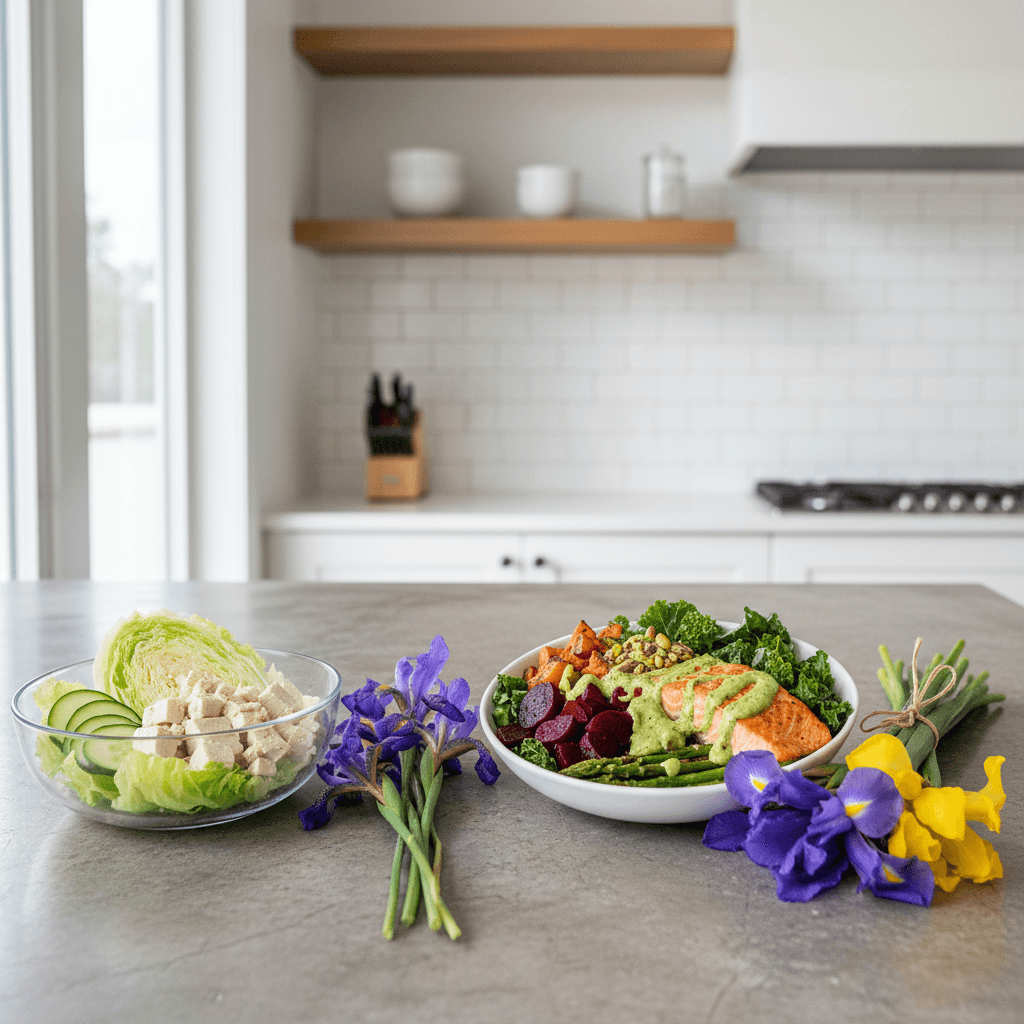
Why You’re Trying to Live Forever on a Diet of Sad Salads and Suppressed Irises (We Have a Better Plan)
The conference room smelled like aspiration and disappointment. I was watching a man my age—let’s call him Jake—give a five-minute presentation on his “longevity stack.” The slide showed 47 supplements arranged like a Periodic Table of Side Hustles. He’d already tackled a 4 a.m. cold plunge, mindful journaling, and (I kid you not) a gratitude walk while wearing blue-light-blocking goggles… in broad daylight.
Jake’s opening line? “I wake up and immediately do red-light therapy so I don’t die sooner.”
Fair enough. We all want to live longer, stronger lives. But while Jake was optimizing his circadian rhythm with military precision, he looked exhausted. Pale. Anxious. In the exact opposite direction of health, really.
This, in a nutshell, is the new longevity paradox: We’re so busy buying “optimal health” that we’re missing viable health. A recent survey by McKinsey pegged the longevity industry at $8.4 billion, yet the same report shows 80 % of survey participants feel more health-anxious than five years ago.
The Real Cost of “Optimize Everything”
Let’s translate the price tag:
- A monthly longevity coach: $1,200
- Precision CGM (continuous glucose monitor, luxury tier): $3,000
- Hand-molded moringa matcha lattes flown in from Kyoto: $14 each
- Standing desk that looks like reclaimed driftwood: $2,800
Meanwhile, the longest-living verified populations—Ikarians (Greece), Okinawans (Japan), Seventh-day Adventists in Loma Linda—have run a multi-century, 200 million-person experiment in skipping the $14 matcha with astonishingly low burnout rates.
What Actually Moves the Needle: The 4-Layer Cake Model
Peer-reviewed longevity science keeps returning to the same four “periodic” patterns. Each layer compounds the others—no purple LED bedroom or peptide subscription required:
Layer 1: Daily Movement That FeELS Good (free—30 min saved in commute sits)
- Data anchor: A British Journal of Sports Medicine meta-analysis of 44,000 added years found that “movement snacks” (squats while brushing teeth, 5-minute post-meal walks) conferred 18 % lower all-cause mortality—identical to 60-minute gym sessions at lower cost.
- Action cheat-sheet: Park an extra block away. Carry groceries in two trips not one. Pretend your phone alarm is a Telegram from 1850: you have to actually stand up to answer it.
Layer 2: “Low Blue Zone Diet” Interface ($3–$8/day)
- Pattern, not perfection: Ikaria >90 % plant-centric, but locals still eat feta, island wine, and Sunday roast. Key: 16-point nutrient density index under-regulated by amazing markets. Translation: frozen blueberries in February achieve para-polyphenol equivalents at $0.29/100 g.
- Swap like a Blue Zoner: Budget Greek dilemna? Canned beans > croutons. Rotisserie chicken > keto bars. Olive oil > seed-oil sauces.
Layer 3: Connection (Priceless, but Saves You Therapy Bills)
- The loneliest cohort: Meta-analysis in PLOS Medicine showed isolation carries the same mortality risk as smoking 15 cigarettes daily.
- DIY social longevity: Eat one scheduled meal daily with someone you like. Text one friend daily. Say “hello” to a cashier (their 10-word convo also shows a 2 % happiness bump in indie study). No app required.
Layer 4: Rhythmic Sleep (Cost: Free, but Replace Netflix)
- Copenhagen clinical trials found that 310,000+ nights of free >$0 sleep tracking showed “blue zone friendly” bedtime (same within 30 min nightly) lowered cardiovascular aging marker AIMP1 by 23
Need Personalized Nutrition Advice?
Get expert guidance from licensed Registered Dietitians. Book a consultation today for just $49.
Book Your Consultation →Related Articles
 The "Optimal" Health Trap
I Thought I Needed “Perfect” Portions… Then My Hunger Signals Returned
I Thought I Needed “Perfect” Portions… Then My Hunger Signals Returned Last summer I stood at my kitchen counter with a kitchen scale, a measuring cup, and a deep sense of panic. A popular macro-tracking app had just told me to eat precisely 3.5 oz of chicken, ½ cup of rice, and 4.2 tsp of […]
 The "Optimal" Health Trap
The Real Reason “I Know What to Do, I Just Don’t Do It”: Why 74% of People Set Themselves Up to Fail Before They Even Start
The Real Reason “I Know What to Do, I Just Don’t Do It”: Why 74% of People Set Themselves Up to Fail Before They Even Start Six weeks into her new plant-based diet, Sarah stared at the wilted kale in her fridge with the same look she gave her gym membership card—equal parts guilt, shame, […]
 The "Optimal" Health Trap
The Permission Paradox: Why Health Coaches Who Try to “Fix” Everyone End Up Helping No One
The Permission Paradox: Why Health Coaches Who Try to “Fix” Everyone End Up Helping No One “Caring too much will never be a mistake, but it could limit your coaching potential.” When I first read those words on Precision Nutrition’s blog, I almost dropped my coffee. Here I was—newly certified, bursting with research, and proudly […]